
Badminton may look simple, but many beginners struggle not because of poor technique but because of misunderstood rules. A rally won does not always mean a point earned, and a good shot can still be a fault if the rules aren’t followed.
For beginners, small rule gaps often cause the most frustration. If they win a rally but the score does not add up, it draws attention away from the game itself. If you want to play with confidence, avoid easy faults, and keep games fair, you must follow these rules. This returns your focus to footwork, timing and shot selection.
This blog provides a guide for beginners to better understand the badminton rules.
What is the Objective of a Badminton Match?
In badminton, the goal is to score points by winning rallies. Each exchange of the shuttlecock constitutes a rally, which ends with the award of a point to either player/pair. Your focus stays on keeping the shuttle in play, placing it inside the correct area, and forcing errors from your opponent. If you score more points within the rules, you win the game. The point is awarded upon the conclusion of a rally. There is no second chance and no debate once the call is made.
General Badminton Rules
- Badminton starts with a toss. The winning player or pair decides whether to serve or receive first or choose a side of the court.
- Players play within the lines of the court. These lines will differ for singles and doubles games.
- Players must not touch the net with their body or racket during a rally.
- Shuttlecock touching the net is acceptable, as long as it goes over to the opponent's side.
- The shuttle must not be caught, carried, or held on the racket during a stroke.
- The shuttle must be hit with one continuous movement of the racket, without double action.
- A side can strike the shuttle only once to pass it over to the opponent's side.
- Player can switch sides after the first game, the second game and in the third game when one of the sides' scores hits 11. This ensures fairness in the game.
Current Scoring Rules
- Badminton uses the rally scoring system. Every rally earns a point.
- A rally is won when the shuttle lands on the opponent’s court or when the opponent commits a fault.
- A game is played to 21 points. The first player or pair to reach 21 points wins the game.
- One side wins the match when they hit the shuttlecock, and it touches the ground on the opponent's side.
- A point will be earned when the opponent commits a fault.
- A fault occurs if the shuttle fails to pass over the net.
- A point is conceded when a shot goes outside the court boundaries.
- A fault occurs if the shuttle is hit twice in succession by the same player or side.
- A point is awarded when a player hits the shuttlecock twice before it reaches the opponent.
- When any side's score reaches 11 points, a 60-second (1-minute) break interval is allowed.
- After a game of 21 points ends, the players are permitted to have a 120-second (2-minute) interval.
Service Rules
- The shuttle must be hit below 1.15 m from the court surface, measured at the lowest rib of the server.
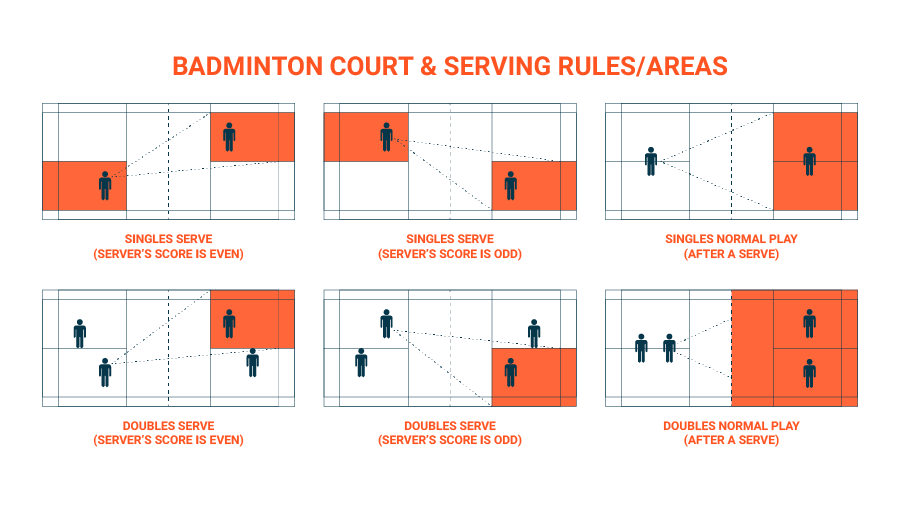
- A shuttlecock must be hit diagonally during a serve. Both feet of the server and receiver must be stationary and in contact with the court until the serve is delivered.
- Players on both sides must remain stationary when a serve is in progress.
-
Playing in singles:
- The player who is serving first for the first game must serve from the right service court.
- If the server won an even point number, they shall serve from the right side of the service court for the subsequent point.
- If the server won an odd point number, then they shall serve from the left side of the service court for the subsequent point.
-
Playing in doubles:
- The player who serves first for the first game must do it from the right service court.
- The server can take the service court according to the point number (right for even numbers and left for odd numbers).
- If the serving side wins the first point, the same person continues to serve (changing court according to the score) until the opponents win a point.
- In doubles, the player in the correct service court serves. Service alternates between teams, and partners rotate service positions based on the score.
- The right to serve in doubles goes from the initial server to the partner of the initial receiver, to the partner of the initial server, to the initial receiver, and back to the initial server.
- No player on the receiving side shall receive two consecutive services in the same game.
- No player can serve or receive out of the turn order.
- Partners may stand anywhere on their side of the court, provided they do not obstruct the opponent’s view of the server.
Winning Rules
- A game can be won by the player or pair who reaches 21 points first.
- A game must be won by a minimum margin of 2 points. If the score reaches 20–20, play continues until one side leads by two points.
- If the score reaches 29–29, the following point decides the game. The side that reaches 30 points wins, even with a one-point lead.
- Badminton is played as a best-of-three game. The first player or pair to win two games wins the match.
Final Thought
Badminton works best when the rules are clear and applied the same way by everyone on the court. Once you know how scoring works, where to stand during a serve, and which lines matter, the game feels cleaner. Your attention stays where it belongs, on movement, timing and shot choice.
For beginners, rules are not barriers. They help them judge rallies fairly and spot faults without stopping the game every few minutes. The more familiar these rules become, the more natural the decisions feel during play.